

AI is amusing us to death.
The unholy power of Gen-AI in social media.

A scene in James L. Brooks’ 1987 film Broadcast News features Holly Hunter’s Jane, an idealistic news producer, giving a speech to fellow journalists. She warns of a growing corporate mandate for news to be more profitable, more efficient, and – in the biggest blow to her – more entertaining.
Replace journalism and news with advertising and AI, and this 38-year-old clip sounds ripped from today’s headlines:
Enter Sora 2, the AI-powered social media app that can take even the vaguest of notions and create compelling 15-second clips of virtually anything. While its outputs seem a far cry from the original high-minded vision of AI ushering in a new era of utopia, it stands to innovate the business model upon which Google, Meta, Instagram and others have founded their empires: social media advertising.
If ChatGPT writes 1000s of descriptions and Sora 2 turns them into thumb-stopping social videos, they can be served to you by an AI-powered algorithm, completely automating the monetization of your eyeballs.
What Is AI Slop?
At the risk of sounding like an old man screaming at the clouds, I’ll admit I’m a fan of a good cat video, and have long loved the warped, lo-fi comedy of Tim & Eric Awesome Show Great Job! and Tim Robinson’s surreal I Think You Should Leave.
But what happens when AI can automatically create an infinite amount of narrative-free novelty videos at scale? Before we answer that, let’s look at some examples, otherwise known as AI slop…
Exhibit A
Prompts:
“Don’t Hug Me l’m Scared-meme creepy video, the cast doing Fortnite emotes.”
“Midwestern dad joke gets him geeked.”
“Doorbell-cam of cat welding nunchucks, the owner comes out to shoo it away. Police dogs show up to arrest the cat.”
As I explored in my last post Sora 2: Atlanta Burns, you can see how short and general the prompts can be, with AI filling in 100s of details automatically...
Exhibit B
Prompts:
“Giraffes are so smart.”
“Audrey Hepburn speaks in brain rot.”
“An elderly person opens the door to greet a cat, gently asking if the little one is lost. Suddenly, the cat unleashes an impossibly powerful, high-pressure torrent of thick water, like a fire hose.”
Check out that first prompt: It’s so general as to be almost meaningless, and yet the video it created feels photo-real and oddly compelling. It’s really just one step away from typing “Make a viral video”...
Exhibit C
Prompts:
“A guy uses a metal detector on a beach. It beeps, but when he digs up what he thinks is metal, it’s actually a tiny band playing heavy metal music.”
“A baby asks his mom about the Epstein files.”
“A hamster screaming in fear rides a chicken, chased by a group of dogs.”
In all three you can see how the photo-real combines with mobile phone vibes and social media aesthetics to blur the line between what’s real and fake (with our grandmothers especially under-equipped to deal with it).
Exhibit D
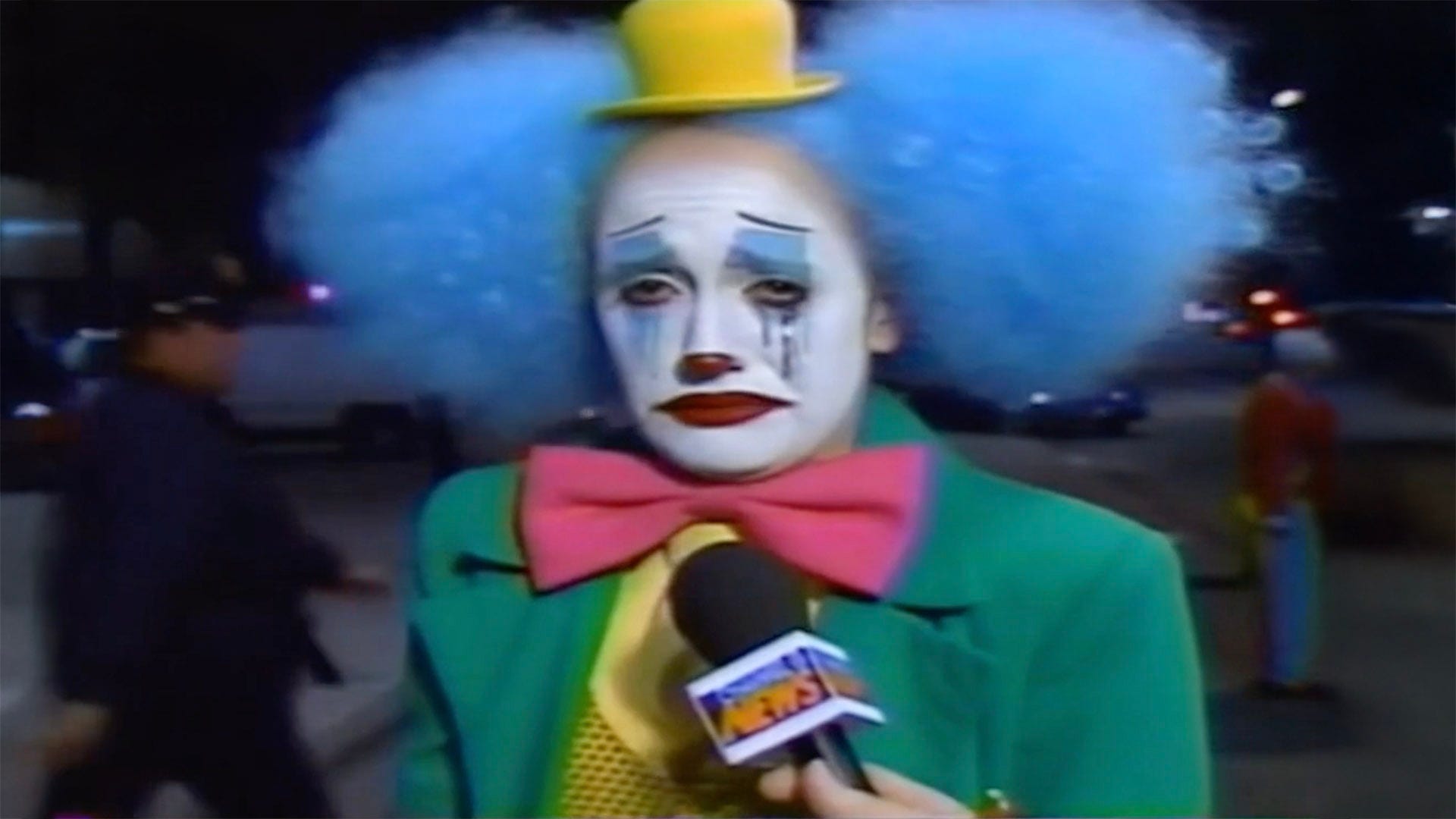
Prompt: “A vintage local news story about a tragic clown car accident.”
From these examples it’s clear AI slop is filled with Shakespeare’s “…sound and fury signifying nothing”. Some readers may even find it depressing, but I also bet many of you would be hard-pressed – like the audience in the Broadcast News clip – to not find at least one of the videos compelling to watch, perhaps even multiple times. (That happened to me with the cat spewing the firehose of water, which legitimately made me LOL.)
So where is this deluge of AI content taking us?
When Everything Is Amusement
Short, narrative-and-context-free novelty has been social media’s stock-in-trade for decades. The problem with novelty is the same problem with junk food: it’s as unhealthy as it is addictive. And when memes are technologically-powered, it becomes even more irresistible.
Amusing Ourselves to Death: Public Discourse in the Age of Show Business (1985), a book by mass-media scholar Neil Postman, speaks about how the rise of television transformed all information into the format of entertainment, which in 2025 seems self-evident. But he went on to say that the contemporary world was reflected not in Orwell’s 1984, with people oppressed by state violence, but in Aldous Huxley’s Brave New World, where the public was oppressed by their addiction to amusement.
Postman likely influenced James L. Brooks’ writing of Broadcast News, and I’d argue his thesis will be more fully realized in today’s AI-powered social media advertising ecosystem. And while Postman perhaps couldn’t foresee the advent of generative AI, this quote about human behavior shows how he foresaw the effect of it:
“People will come to adore the technologies that undo their capacities to think.” – Neil Postman, Amusing Ourselves to Death (1985)
Even after 40 years, I can’t think of a more succinct warning about this AI moment.
The Choice Before Us
We’re glimpsing a future where taking the human completely out of the loop of short-form social content is a very real possibility. If a technology helps companies maximize advertising profits by streamlining audience targeting and automating the content that keeps people on their platforms, they’ll do it.
There’s a phrase in marketing which embodies the ambition to capture all demographics of the audience: “cradle-to-grave.” I propose we’re now seeing the path to a kind of cradle-to-grave advertising prison, where the creation of the content, the placement (and even generation) of the ads, and the targeting of the audience is 100% automated with AI, at an incredible level of precision. (How this affects the dissemination of political propaganda is another post entirely.)
So the question is…
Do we let these profit-focused companies decide how AI is deployed in the world, or do we humans stand up for what it means to think, create and communicate in culture, and define the line across which AI should not tread?
I’ll end with a scene from the film Network (1976), written by Paddy Chayefsky, where Ned Beatty’s CEO lays out the natural order of things to anchorman Howard Beale.
It’s clear the fight will not be easy.
Scene from Network (1976)
Postscript
Like any tool, AI can be used for good or ill, generating automated slop or empowering human expression. With November being the 3rd anniversary of the “ChatGPT Moment” that started the AI hype cycle, my next series of posts will highlight what these years of AI in the hands of creators tell us about how to use it…
I've never seen Broadcast News, but that clip is great! Eerily prescient for sure.